Each year since 2009 I’ve spent the first weekend of December photographing kids as they visit with Santa at Bellingham’s Holiday Port Festival, at the Bellingham Cruise Terminal in Fairhaven. We see quite a few children come back year after year. It’s fun to watch them grow up, and to share their wishes with Santa.
This video slideshow is of the kids who visited Santa on Friday evening, December 6, 2013.
It had been six years since my last visit to Waterworks Canyon, a gem of a place for early season wildflowers west of Yakima, Washington. This past Sunday I returned, this time with my wife, Natalie, and my son, Zach. Little had changed since April 2007, which is a good thing. This only significant difference is that a Washington Discover Pass is now required to park at the trailhead (Google map satellite view).
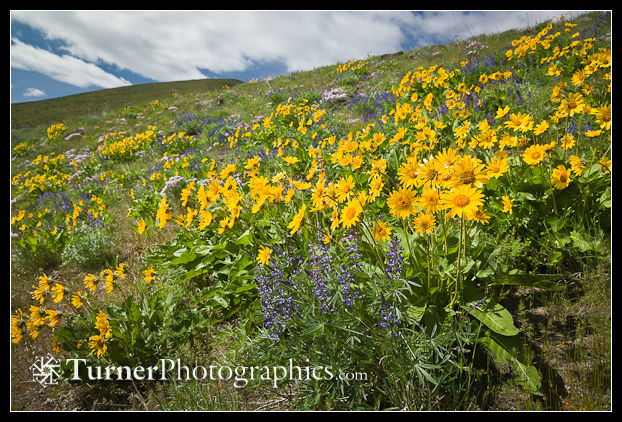
Bingen Lupines, Carey’s Balsamroot & Showy Phlox
The flowers were spectacular right from the beginning of the trail, which leaves Washington Route 410 about a quarter mile west of the junction with US 12 in Tieton Canyon a few miles west of Naches and Yakima. Pass through the gate and before you’ve made many steps the hillside explodes with brilliant yellow balsamroot, rich blue lupines, and bright pink showy phlox. These will be your showiest companions along much of the trail as you climb 1,000 feet or more up the canyon on a well-worn boot track, crossing and recrossing a small stream that sometimes disappears underground.
Ball-head Waterleaf
Most of the hike is on rocky ground in full sun, but there are a few sheltered and shady spots that hold a bit more moisture. Here you’ll find ball-head waterleaf and star-flowered false Solomon’s seal.
We also found patches of deep blue Menzies’ larkspur, pale blue trumped lungwort, and the last few blossoms on sagebrush buttercups. Prairie stars were thick on places, scattered among the grasses in others. Thompson’s paintbrush was just starting to show its yellow bracts, and linear-leaf daisies were still in bud.
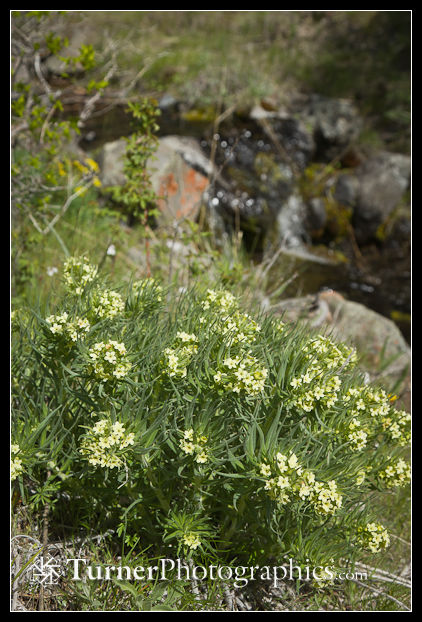
Columbia Puccoon
There were numerous clumps of Columbia puccoon. This one, beside the stream, was among the nicest of them. This is a plant that nearly always grows in clumps like this. I can’t recall ever seeing just a single stem of it anywhere.
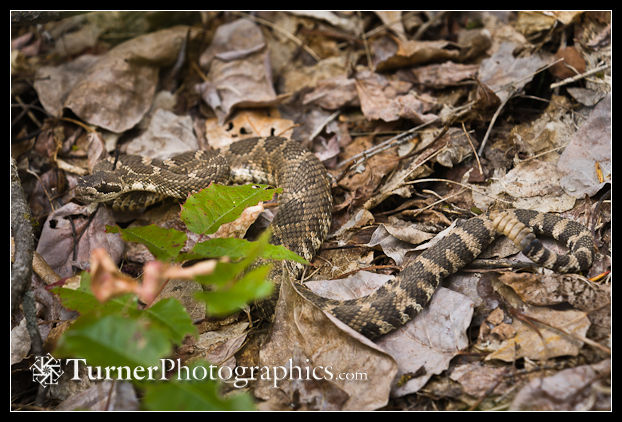
Western Rattlesnake
A special treat was encountering a small western rattlesnake along the trail. This guy (I presume it was a guy, but I didn’t try to determine its sex) was just a couple of feet off the trail in one of the wooded sections. I surprised it as I walked by, invoking the distinctive buzzing of its rattle. Natlie and Zach stopped below the snake and we all watched it for a while. I put my longest lens (70-200mm plus a 2x teleconverter) on my camera before photographing from a safe distance. This is not a subject I wanted to photograph up close with my pocket camera or iPhone. After I finished shooting Natalie and Zach stepped quietly past the snake and continued on up the trail.
I don’t encounter snakes of any kind very often when I’m out hiking, although when in rattler country I always keep my eyes and ears open for them. I would have been less surprised to encounter one out in the open among the rocks than in the woods. But I’m not a herptologist and don’t really know a whole lot about rattlesnake habitat and behavior.
Sunday morning Natalie said, “let’s go for a walk in the woods” and I suggested we hike the loop trail at the Stimpson Family Nature Reserve near Lake Whatcom. It’s an easy 3-mile loop through nice old- and second-growth forest, perfect for a quick getaway on a morning when light rain threatened.
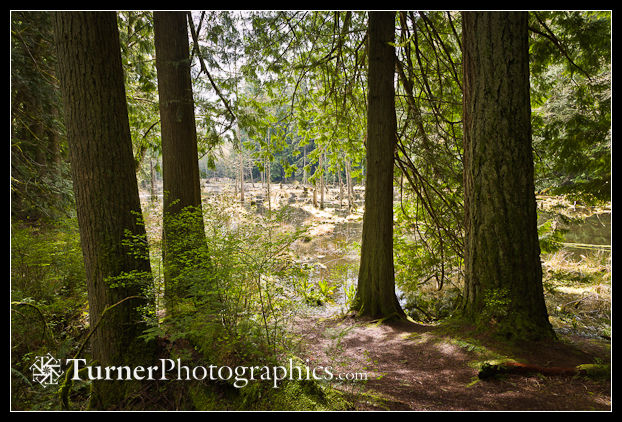
Beaver pond wetland
Just a tenth of a mile up the trail there’s a viewpoint to a large beaver-built wetland. This is the view from the trail, with the wetland framed by western redcedars, Douglas-firs, and red huckleberries. The wetland plants are still brown, not yet having started their spring growth in the cold water.
A few days ago I had a little time to kill between appointments in Fairhaven so I headed down to the North Chuckanut trailhead for Bellingham’s Interurban Trail to see what I could find. It was a glorious warm and sunny spring day, somewhat uncommon for late March around here. I didn’t have a lot of time so I didn’t hike far with my camera and tripod slung over my shoulder.
The Northwest Flower and Garden Show, held in Seattle each February, is one of the world’s greatest garden shows. Here in the northwest it’s an event we look forward to each winter as the days begin to lengthen, buds swell, and the earliest flowers in our gardens begin to bloom.
The warm and dry environment of the Washington State Convention and Trade Center, all decked out with fabulous display gardens, welcomes gardeners from across the country to this annual extravaganza of garden theater. This year’s theme is “The Silver Screen Takes Root…Gardens Go Hollywood” and the garden designers did a good job interpreting this very broad and fun concept.
The first garden you encounter on the way into the show takes you on a journey to Oz, with Dorothy, the Tin Man, and a daffodil-filled golden brick road.
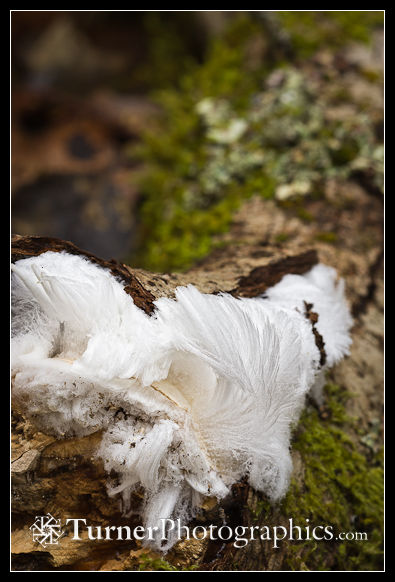
I’d never heard the term “frost flowers” until one of my editors and customers requested photographs of the phenomenon late last year. This is a natural phenomenon that occurs during the freeze-thaw cycle, or at the beginning of winter in places that don’t cycle through warm and cold periods. Continue reading →
Photographers, and artists of all kinds, learn to see light. We look at where it’s coming from, how it plays on our subjects, and how much contrast it yields.
I made this series of images last week during the field demonstration part of my pocket camera wildflower photography class at the North Cascades Institute while my students watched me work. They looked at the images immediately on my iPad so they could compare what they saw from where they stood with what I was getting as I moved around my subject and then used a couple of diffusers on a close-up.
Photographer’s Shadow: Front Light
We were at the Bridge Creek trailhead, where the Pacific Crest Trail crosses Washington Highway 20. These Giant Red Paintbrush (Castilleja miniata) were just a few feet from the edge of the parking lot. It was about 9:15 in the morning under a cloudless blue sky, so the sun was about 30° above the horizon and more than halfway to its peak. In short, the sunlight was strong, high, and bright. In the first photo you can see my shadow as I stood with my back to the sun. Continue reading →
I got a phone call this morning from a lady down around Olympia who had come across my wildflowers website. She hadn’t found a plant on the site that she’d found in the backyard of her home and asked if she could send me a JPEG to identify it for her before she took a weed eater to it. I get these requests pretty frequently, but usually by e-mail, so I said “yes” and she sent a file while we were still on the phone.
It only took a glance to know that her mystery plant was the very common garden groundcover, Vinca minor. The common name is periwinkle. It’s a plant I learned as a small child because my dad had it in our garden. It’s native to southern Switzerland and south to the Mediterranean. Continue reading →
Comfortable, attractive outdoor living spaces never go out of style. Ideas from one part of the country can usually be adapted to other regions, so a photo of an inviting space makes a great magazine cover.
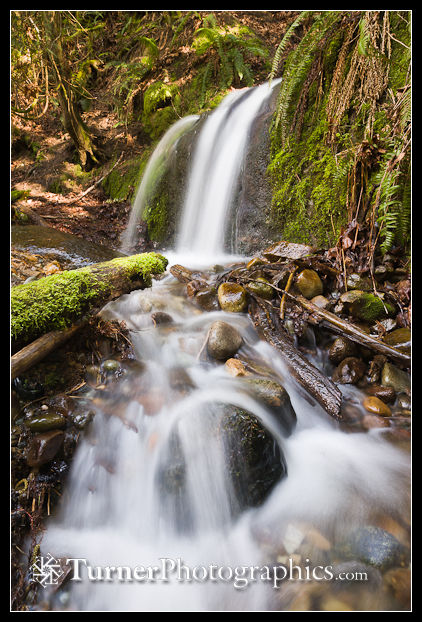
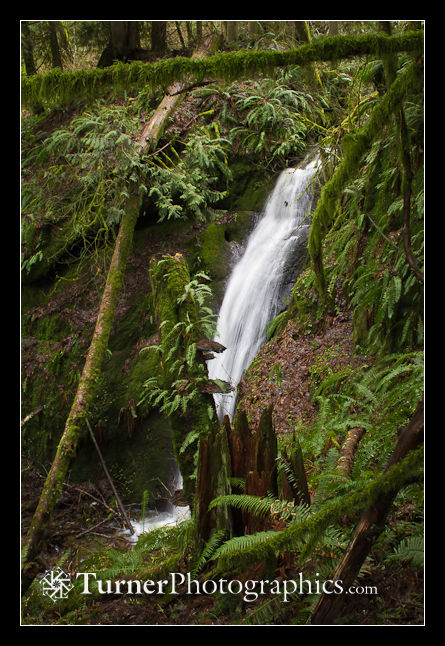
I’m a sucker for waterfalls. There’s just something about the patterns of flowing water that draw me in. They’re not a subject that’s been lucrative but I can’t resist photographing them anyway.
Chuckanut Falls
This is Chuckanut Falls, on a tributary to Chuckanut Creek in Arroyo Park just south of Bellingham. There’s a new trail, just built in the last year, leading to the falls. The falls trail takes off from the trail heading up from the Interurban Trail toward Lost Lake. The signed junction is just downhill from the top end of California Street. Continue reading →