Deep Snow

wp9c9033.jpg

The storm cell that brought deep snow to the area sat over Spokane for nearly 30 hours and dumped a couple of feet of snow. That’s more than people here can remember in many, many years. Schools, many government offices, and some businesses were closed today.

Fresh snow doesn’t look good for very long, so I headed out in the brilliant morning sunshine to visit three more gardens today. The greenhouse in the photo was just added to Sherrie & Ron Guiles’ garden last summer. The tree in the foreground is a cutleaf Japanese Maple, which maintains its characteristic shape even under the thick snow cover.

Walking around in the garden where Ron & Sherrie hadn’t used their snowblower to create paths was challenging because the snow came up to my knees. As before, I had to plan my route to keep my footprints out of future photos.

In one area of the garden the outline of a boxwood parterre was barely visible as a soft raised swirl of snow. Everywhere I looked, the contours and textures that had been so prominent and colorful during the growing season and into autumn were soft, flattened, and muted into shades of blue shadows and golden highlights.
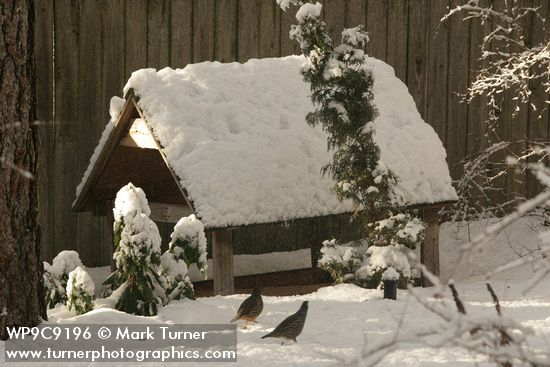
wp9c9196.jpgThe second garden I visited today is a wildlife garden, and in the winter it is a haven for nuthatches, chickadees, pine siskins, house finches, flickers, mourning doves, and dozens of California quail. Bird feeders hang from many trees, and a large covered ground feeder gives a sheltered place to feed near thick shrubs which offer protection.

I shared lunch with Eva & Del Lusk, enjoying the view out the large windows overlooking the garden and watching the birds. Unfortunately, the birds aren’t nearly as comfortable with a photographer wandering around with a long lens and a tripod. I set up several shots and stood very still and waited for the birds to return, but mostly came up empty-handed. My feet eventually got cold and I gave up.
Crazy for Snow

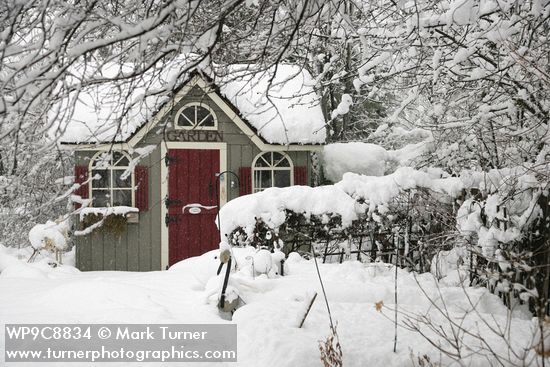
wp9c8834_std.jpg

I’ve been waiting all winter for the conditions to be right to visit several eastern Washington gardens when there’s lots of fresh snow. Today (January 27) I hit the jackpot as Spokane received near-record snowfall of up to 12 inches while I was out photographing. It would have been better if the temperature had been a few degrees colder and snow a little drier, but it was still a fantastic day.

The garden shed shown here is in Cathi and Dave Lamoreux’s back yard on the far south edge of Spokane. The snow in their yard was over a foot deep and getting deeper seemingly by the minute.

Photographing in the snow presents some challenges that don’t exist in warmer conditions. First, I had to keep my camera covered to keep it dry. I used a cheap plastic rain cover that cinches down around the lens and allows me to see the LCD on the back through the plastic. There’s a little hole for the viewfinder, and I operate the controls through the plastic. It’s a bit awkward, but workable.

The biggest challenge is one of planning. With no snow on the ground it doesn’t matter much where the photographer walks, as no evidence remains. But when there is snow, every footstep has to be planned so they don’t show up in some future shot. I find myself spending extra time thinking ahead to what other angles I’m going to want to capture before I start walking around.

When the weather is as warm as it was in Spokane today — right around freezing, staying warm while working really wasn’t much of an issue. Long underwear, rain pants, and a waterproof parka did the trick to stay warm and dry. Basically it’s just like dressing for any other winter outdoor activity in snow country.

I plan to spend another couple of days photographing Spokane gardens before heading back across the mountains. It’s predicted to get colder and maybe a little more snow, so conditions should remain favorable. But the only way to know for sure is to look out the window in the morning.

Captioning Marathon

This is the dark and rainy season in the Northwest, so it’s a good time to get caught up on captioning.  That’s a good thing since I have a backlog of around 5,000 images to edit and caption from mid-September to now. I didn’t have time after my Kelowna trip in September before going to Oklahoma and then immediately to Spokane and Coeur d’Alene.

Captioning is a somewhat tedious process that requires identifying as many of the plants in each photo as possible, checking proper names and spelling, and entering the data both in my master database and in the metadata fields associated with the digital image files themselves. My record for number of photos captioned in a day is around 600, but most days I don’t hit that figure.

One of the challenges is simply forcing myself to stay in my seat in front of the computer. Sitting for long periods is tiring and definitely isn’t good for my body. But there’s no way to get captions written without sitting and concentrating on the task.

Autumn Rain

Japanese Maples on Rainy Autumn Day

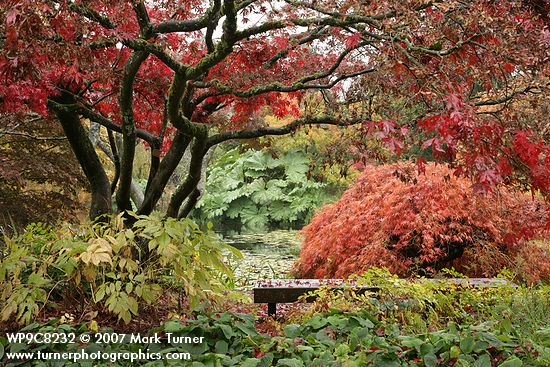
Rainy days in the garden can yield intensely rich and saturated colors. Last Friday I went up to VanDusen Garden in Vancouver, BC, which is one of my favorite public gardens. After a lengthy strike which closed the garden (as well as libraries and halting garbage service) for 12 weeks, the garden was once again open. The weather forecast for the day was mixed and I hesitated about going out. But I checked the weather radar and it looked like the biggest part of the rainstorm had already moved through.

Soon after I arrived in the garden it started to rain, so I pulled out a plastic rain cover for my camera and continued working. Some of the fall foliage was past its prime, but there was enough lingering to make it worth my time to explore and photograph.

The photo above was made during a break in the rain, but under heavily overcast skies. It’s one of my favorite Japanese maples in a grove along the shore of one of the ponds in the park. I’ve photographed it many times, in most seasons, and under many weather conditions.

Working in the rain is certainly more challenging than photographing in “better” weather. Keeping the camera dry is the big issue. An umbrella works, but can be hard to hold while setting up the shot. I’ve used a cheap plastic grocery bag, but inevitably the camera still gets wet. Currently I use inexpensive rain covers from Optechs. My camera still gets a little damp, and changing lenses is slightly inconvenient, but overall this clear plastic cover works pretty well. I hang it up on a doorknob to dry when I get home.

Besides keeping the camera dry, another issue in the rain is low light levels and moving subjects. Raindrops make plants shake, and rain is often accompanied by wind. Like any windy situation, there’s often a brief pause between puffs of wind so I set up and wait. I think the results are worthwhile.

Awash in a Sea of Data

I finished backing up the last week’s camera raw files this afternoon.  It’s a process that takes the better part of a day to make DVDs.  In this case, twelve nearly-full disks of data.  Then after I edit and caption the photos I need to back them up again.  That’s one of the downsides of the digital photography revolution.

I’ve also completely filled two 200GB hard drives with raw images in 2007. I think it’s time to shop for bigger replacement drives so I can keep working.  At least with increasing drive capacities and falling costs per megabyte of storage it’s not an unreasonable prospect.

When I was shooting film I began running out of shelf space to store notebooks full of slides.  Every wall of my office that doesn’t have a window or a door is covered with shelving. I don’t know where I would have expanded my slide storage if I hadn’t gone digital.

In the last 30 days I’ve been shooting more days than not and now have over 5,000 frames to edit and caption. That means looking forward to a lot of hours in front of the computer screen in the coming weeks.

The Shortest Season

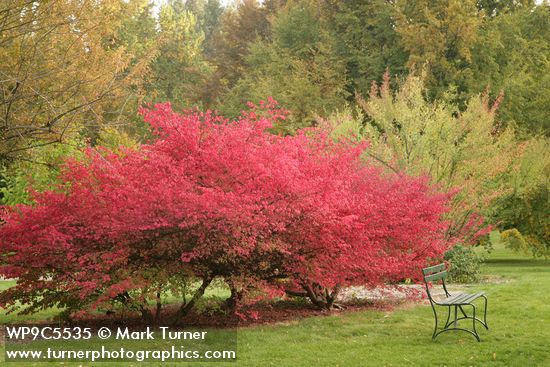
Burning Bush in Finch Arboretum

I’m not sure why I never thought about it before, but I realized the other day that autumn is our shortest season.  Not according to the calendar, but in the way we perceive it. When we think of fall, the thing that comes to mind is brilliantly colored foliage, like the burning bush in the photograph above. However, the time span when any individual tree or shrub is in its colorful glory is disgustingly short — often measured in mere days and almost never more than a couple of weeks.

For the serious leaf-peepers who make the pilgrimage to catch the best color in New England, the Appalachian hardwood forests, or the aspens in the Sierras there are websites that track the color change. The timing of the season depends on several factors, including recent rains and whether there’s been a frost. It’s hard to predict far in advance.

I am in Spokane and vicinity for a few days to catch what I hope will be the peak of color in gardens on the east side of the Cascades.  This afternoon I stopped at Finch Arboretum on my way into town and photographed a handful of specimen trees in the low sunlight. Golden rain tree, catalpa, honey locust, crab apples, and some of the maples were all putting on a fine show.

Tomorrow is predicted to be cloudy and possibly rainy, which will give a very different feel to the gardens I plan to visit and photograph. I actually hope there is a little light rain, but no wind, to accentuate the colors.

Relaxing Oklahoma City Garden

Tropical Foliage around lounge chairs

This morning I visited the incredible garden of Aaron Baker and Michael McMahill in Oklahoma City as part of the Garden Writers Association annual symposium tours.  What a pleasant surprise upon exiting our tour bus to encounter this delightful small garden in the middle of the continent. Everywhere we looked there were tasteful touches of whimsey, appropriate integration of art and humor, good choices of plants, and an abiding good taste. Aaron and Michael were gracious hosts as busloads of garden writers trouped through their private back yard on an otherwise quiet Sunday morning.

Touring gardens with hundreds of other garden communicators presents special challenges to the photographer.  Particularly, how to keep parts of bodies out of the frame and staying out of the way of other photographers in the group. Inevitably some degree of compromise (and a lot of patience) is required. Some photographers give up and don’t bother, but I find that the level of excitement and enthusiasm from working at a “speed photography” pace can pay off with some nice images.

The vignette in the photo above is just a tiny bit of the garden. Here a collection of containers with tropical-look foliage frames a pair of chaise lounges.  Just out of sight to the left was a bubbling hot tub sunken into the deck and behind that a covered outdoor dining room. In the front yard the couple had placed several unusual gourds and pumpkins among succulents and other foliage plants to begin to give an autumn feel to the garden. The garden was a wonderful example of what creative people can accomplish in a small space and without extravagant sums of cash.

On the Cusp of Autumn

I’ve spent the day photographing in four Kelowna, BC gardens. It’s definitely a transition time — not quite autumn but yet it doesn’t look like summer any more. The weather played a role, but more significant is what’s happening with the plants. Foliage is just beginning to turn in a few places, but Kelowna is still probably a couple of weeks away from the best color in the trees and shrubs.

Fall Grasses at Elysium Gardens

These grasses were photographed late this morning at Elysium Gardens on the south side of Kelowna. In the foreground is Calimagrostis acutiflora ‘Karl Foerster’ and on the right is Miscanthus sinensis ‘Purpurascens.’ The gardens at Elysium had several other grasses artfully placed and generally towering over other foliage in the perennial beds. With sunlight alternating with clouds the grasses made a striking sight.

Several Hydrangea paniculata were showing a nice pink in their aging flowers, contrasting with variegated summer phlox and ‘Diablo’ Ninebark. Joe Pye Weed rose above Goldenrod that was just finishing blooming and Frikart’s Asters were scattered about with their large pale purple blossoms.

You only have another week to catch the display at Elysium, as it closes for the season at the end of September. If you haven’t visited, you should make plans to, whether next week or next season.

The other gardens I photographed today were also repeat visits from the summer. Rob Bruce, who had glorious roses in June, had a more subdued garden today. The unique plant was an annual vine in the pea family with large purple pods, but Rob couldn’t recall the name of it this morning. Nick and Teresa Manduca had a very nice clump of Autumn Crocus in the rock wall along the path in their side yard and an Autumn Clematis in full bloom along the yew hedge by the driveway. John Noble’s collection of Japanese Maples haven’t started to turn yet so the garden was quite subdued, particularly as it started to rain while I was working.

Chasing Autumn

We’re still a few days away from the official start of Autumn (September 23 this year), but it sure doesn’t feel like summer any more.  I was out in a garden near Ferndale a couple of days ago and it doesn’t quite look like autumn yet, either.  Late summer flowers were still blooming and grasses were beginning to flower. The weather was definitely fall-like — overcast, spitting rain, and windy. Our night-time low last night was about 40° F.

I head up to Kelowna, BC tomorrow to revisit several of the gardens I photographed in early May and mid-June. Some of the gardeners have said it is too early while others say their gardens are looking good. Catching the peak of autumn is a challenge and there are many places I’d like to catch that peak.  Hopefully I’ll be in at least one of them at the right time.

I’ll be putting a new lens to the test on this trip.  I just received the Canon 24-105mm f/4 L, which is reportedly a little contrastier and sharper than the 28-135mm I’ve been using for several years.  I made a few test shots in our garden today and they look good. I forgot to test for vignetting at the wide end, a problem I’ve been experiencing with the 28-135 when there’s sky in the corner of the frame.

Fall Vegetables

Back in August I visited two families in central Oregon that grow incredible vegetable gardens. Jim and Ardyce Swift, in Terrebonne, extend their season with two greenhouses for winter vegetables. They showed me snapshots of tomatoes and strawberries ready to pick in the middle of winter. Of course, their propane bill for the greenhouse is more than for their house. Lance and Jennifer Barker grow most of the vegetables they eat in their Bear Valley garden at 5000 ft. elevation about 20 miles south of John Day. Officially, they have no frost-free months. Lance is the primary gardener and over the years he’s learned which varieties work and numerous techniques for extending the season.

When I got home I was motivated to put some effort into growing fall and winter vegetables in our own garden. Bellingham has a pretty easy climate for fall crops, but it’s important to get them in the ground soon enough. Fall gardening doesn’t mean planting in the fall, but harvesting then. Planting seeds in mid-summer means the soil is nice and warm so they germinate quickly as long as you keep the soil moist. That means daily watering since we don’t get rain in the summer. I had to break my deep-seated prejudice against watering every day, but I’d seen what it could do in lots of east-side gardens this year.

On August 12 I spaded, cultivated, and worked a couple of wheelbarrows full of organic matter into three of our vegetable beds. Then I planted ‘Garden Babies Butterhead’ Lettuce, ‘Bright Lights’ Rainbow Chard, ‘Romeo’ Round Baby Carrots (all from Renee’s Garden) in one bed. In another bed I planted ‘Tyee Hybrid’ Spinach and ‘Early Dividend Hybrid’ Broccoli (both from Territorial Seed Company). Along the garden fence I planted ‘Cascadia’ Snap Peas (Territorial) and ‘Heirloom Cutting Mix’ Lettuce (Renee’s).

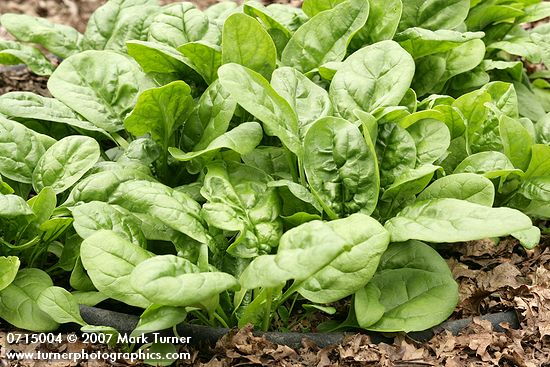
It’s been a month, and we’re just about ready to start eating spinach, chard, and lettuce thinnings. Here’s part of the spinach patch:

Spinach at 31 days

A week later, on August 19 I prepared and planted another bed and worked a fall crop into holes in a summer bed. I put in patchs of ‘Winterbor Hybrid’ Kale, ‘Bull’s Blood’ Beets, ‘Altaglobe’ Radishes, and ‘Melissa Hybrid’ Cabbage (all from Territorial). They’re all going strong, too.

The organic matter I worked into the beds included partly-composted leaves and garden debris. My compost piles almost never get hot enough to kill all the weed seeds, so I’ve had to pull lots of little weeds from around my vegetables. It really doesn’t take long to pull them and gently cultivate the soil with my fingers when the weeds are tiny. The work provides a nice break from sitting in the office working on captioning photos. I also had to put down slug bait since new little vegetable plants are a slug delicacy.

Now that the plants are coming along, I’ve got new photo subjects as well. It’s rather nice to be able to grow my own subjects, and then when they’re big enough pick and eat them. Shooting in my garden forces me to look closely for the weeds and get them out of the way. I also select for the nicest-looking plants. They may taste the same with a few bug holes, but they don’t look as good. I get down close to ground level to photograph the new plants since I think they look better from the side than from straight down. Recently, I’ve been using my Canon 90mm TS-E tilt-shift lens to control the plane of focus, sometimes with an extension tube to get closer.