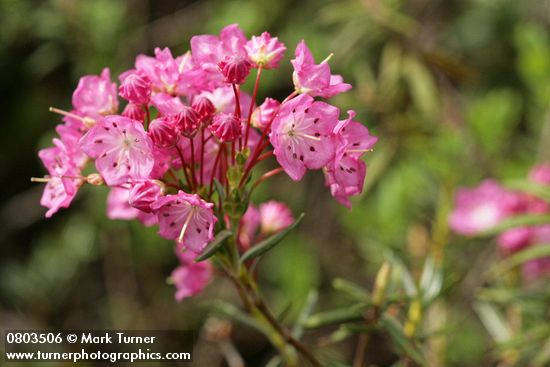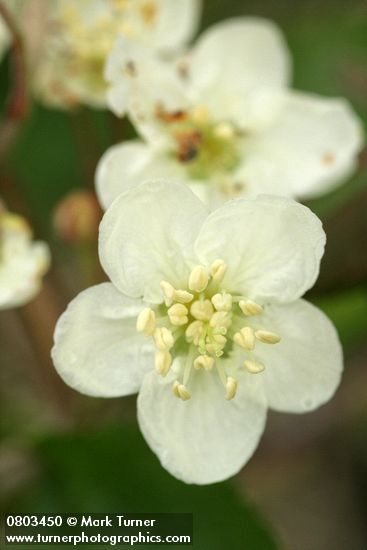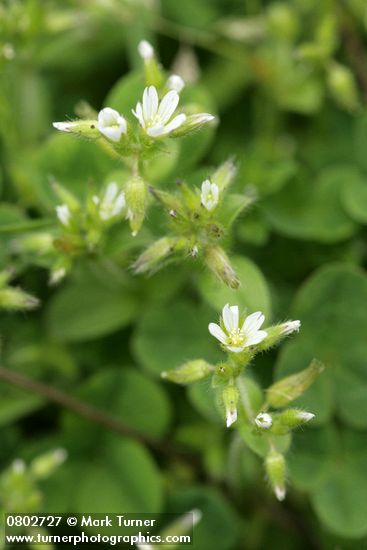
Pursuit of a Penstemon

Posted on by

A fellow wildflower enthusiast told me that one of the penstemons I missed finding for Wildflowers of the Pacific Northwest grows at Peshastin Pinnacles State Park near Cashmere in the Wenatchee River valley.  Peshastin is a popular rock climbing area and I helped to build the trails there back when it first became a park in the early 1990s. So yesterday I stopped by on a meandering route from Bellingham to Pendleton, Oregon.
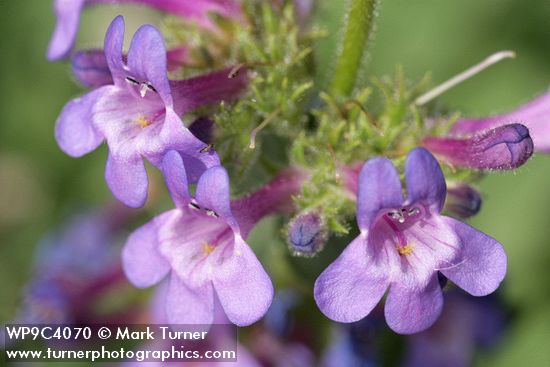
Chelan Penstemon

The penstemon on this quest is Chelan Penstemon, Penstemon pruinosus. I found what I thought was it not very far up the trail from the gate to the climbing area and stopped and made many photos. But then I found a different penstemon blooming farther along and in a more rocky habitat. I spent time with the key in Hitchcock on both of them and thought the first one I shot was what I was looking for. But then I had doubts.

This morning I drove up river from Wenatchee a short distance and stopped for purple flowers on the rocky slope beside the road. I thought when driving by that they were purple sage, Salvia dorrii, but when I got closer I saw they were penstemons. I pulled the key out again and this time decided I really had found Penstemon pruinosus. That’s the plant in the photo above. I find penstemons hard to key out — the key starts with the way the pollen sacs split open and includes the seeds. I’ve spent a lot of time keying penstemons and still not felt completely confident of the result. Lupines and paintbrushes are also difficult, and let’s not even get started on Astragalus.

In Leavenworth I stopped at the ski hill, which is a wonderful place for flowers in the spring. I found a patch of Trillium petiolatum, roundleaf trillium, along a trail and made some fresh images.  Arrowleaf balsamroot and lupines were blooming in the ponderosa forest, and I found a nice patch of star Solomon’s seal with more blossoms that I typically see.

Today was productive with a visit to Ohme Gardens in Wenatchee, then a stop along the Goldendale-Lyle highway to photograph Lomatium suksdorfii, which I’d misidentified a few years back. Finally, a stop by Roland Lake in the Columbia Gorge for some fresh images of the endemic Barrett’s penstemon which blooms on the basalt cliffs beside the old highway.  It’s going to take a while back in the office to get everything edited and captioned.

Last night I slept in the back of my truck up a forest service road near Leavenworth. I had peanut butter & jelly sandwiches for lunch and dinner today, but treated myself to a motel room in The Dalles tonight so I could get clean and charge batteries before visiting with a garden club group in Pendleton on Monday.
Office or Field?

Posted on by

The hard reality of my independent photography business is that I have to do everything. Like most photographers, I’d much rather spend the majority of my time behind the camera creating new images. Working in the office is a necessary part of the job, otherwise there would be no customers and no income. Sometimes the concept of being retired and just shooting for fun sounds very appealing.

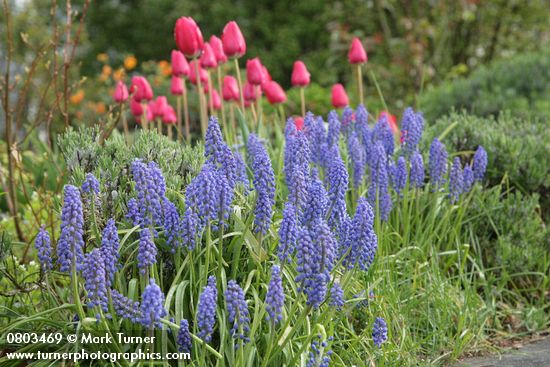
Grape Hyacinths and Tulips

There always seems to be too much to do in the office and not enough hours in the day. After every shoot I copy the digital files to my computer, add basic location and contact metadata, then back up the camera raw files to DVD. Then I go through the files and edit the take, deleting the poor exposures from bracketed sets, excising the ones where the wind blew the subject around and blurred the image, and getting rid of anything else I don’t like. Next step is captioning, which almost always includes Latin and common names for the plants and a short description. I often have to look up names, check identifications, or verify spelling. Sometimes it takes almost as long to caption as it does to shoot. So I get behind. These grape hyacinths and tulips were photographed in our garden on April 29 and captioned on May 15. I still have five days of garden photography to caption.

The other office task that can be very time-consuming is selecting photos in response to an editor’s request. Last week I spent the better part of two days assembling private web galleries of images for a garden magazine. The wantlist, single-spaced, ran to more than four pages of plant names for several stories. I had a lot of the species on the list, and for many of them I had many choices. The process is simple, but tedious. I look up the plants in my database, look at the photos on my computer screen, select the ones I think are appropriate, and add them to a gallery. Repeat until done. Sometimes the photos are in my slide collection and I’ll have to scan and optimize them. I store my scans on a networked drive and it’s slower than internal computer drives so I wait for the computer. When I’ve finished selecting photos I generate a web gallery, upload it to my server, preview it to make sure there aren’t any problems, and then send a link to the editor that requested the images.

Often, editors don’t even acknowledge that they’re received the e-mail link. I only hear from them when and if they’ve selected one or two photos and need a high-res file ASAP. That’s another office task that can’t be automated.

Enough of this, it’s time to go find some fresh flowers in bloom. I’m off in search of a penstemon at Peshastin, a biscuit root at Goldendale, and gardens in Pendleton and Yakima. Who knows what else I’ll find along the way.

Depth of Field Bracketing

Posted on by

Photographers often bracket exposures, shooting what the meter says and then a little overexposed and a little underexposed to make sure they get one that is perfect. It’s just as important with digital as with film as digital sensors are prone to blowing out overexposed highlights and shadows can get noisy. But there’s another bracketing technique that I also find useful.

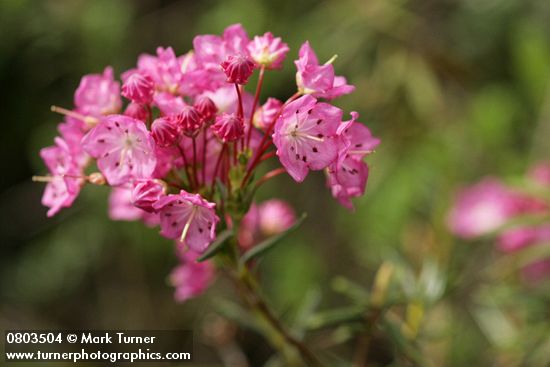
Bog Laurel blossoms (f/5)

I photographed these Bog Laurel, Kalmia microphylla, blossoms yesterday afternoon at Burns Bog in Delta, British Columbia. I like to separate the main subject from the background, and one of the effective ways to do that is to that is to shoot at a relatively wide aperture to the plane of focus from front to back is shallow. The background goes soft. In the photo above I used f/5 with my 100mm macro lens. I like the soft background, but only the buds and the blossom on the right are truly sharp.

Bog Laurel blossoms (f/8)

Then I stopped down just over a stop to f/8 and made another exposure. You can see that the background is not as soft in this one, but more of the blossoms are sharp. I used my camera’s depth of field preview before I shot, checking smaller apertures as well. By the time I got to f/11 the background was too busy and I didn’t waste time shooting that one. I still haven’t decided whether I like the softer background or the sharper flowers better. With Photoshop I could combine the two and I think it would still look natural, but that’s a fair amount of work. In any case it’s all about choices, and sometimes it’s easier to shoot several variations and make the discriminating decisions later.

Burns Bog is a unique and disappearing ecosystem in southern British Columbia. It’s being pushed in from all sides by farming, development, and highways. As I was working along the boardwalk through the Delta Nature Preserve, the only part of the bog currently open to the public, my ears were constantly assaulted by the sound of traffic on nearby highway 91 at the south end of the Alex Fraser bridge over the Fraser River. On my visit yesterday the shrub thicket of Labrador Tea and Bog Laurel was just beginning to bloom. I’ll go back in a week or so when there should be more blossoms. See more of yesterday’s photos at Pacific Northwest Wildflowers.

Native or Escaped?

Posted on by

I’ve been working up a list of plants that I didn’t find in bloom for Wildflowers of the Pacific Northwest, or that we didn’t plan to include for one reason or another. One of those plants is a small shrubby tree, Pacific crabapple. Phyllis and I left it out of the book because we mostly excluded trees. I’d never made an effort to find it until this year. I asked my native plant colleagues for help finding where it grows and several people pointed me to locations. I found plants a week or so ago, but not in bloom.

Pacific crabapple blossomI also found lots of escaped cultivated apple trees blooming in the woods and near wet areas where the native crabapple grows. While some of the escaped apple trees are quite big, it’s easy to confuse them with the native. The flowers look a lot alike, especially when you find an apple with white instead of pink blossoms. You have to look close to see the difference: 3 pistals in the native crabapple and 5 pistals in the domestic apple blossoms.
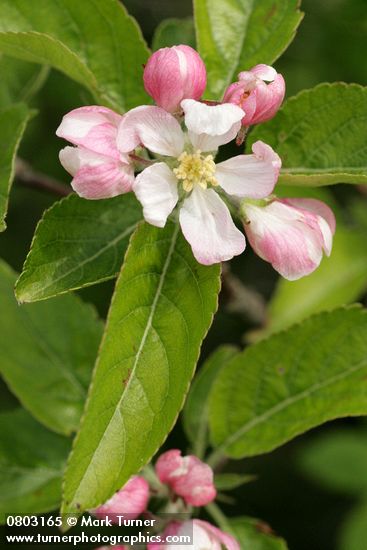
This is a blossom of the Pacific crabapple, Malus fusca, which has 5 white petals, about 20 stamens, and 3 pistals. Sometimes the leaves on the crabapple have a small lobe on one or both sides, but not always.

I found this specimen just starting to bloom in the Connelly Creek Nature Area on Bellingham’s south side. More photos are on Pacific Northwest Wildflowers under May 14, 2008.

Cultivated apple blossom

This blossom is on an escaped cultivated apple, Malus pumila, which has 5 pinkish petals, about 20 stamens, and 5 pistals. It’s difficult to count pistals in a photo, even when viewed at higher resolution than is possible on the web. It can be challenging even in the field. Very good close-up eyesight or a hand lens is essential. I found it helpful to pull the stamens off a blossom so I could clearly see the pistals.

You can see more photos of the cultivated apples that initially fooled me, as well as some other plants in bloom around Bellingham on May 6 at Pacific Northwest Wildflowers.

Sometimes distinguishing what’s native and what’s not is even more difficult.  For example, Prunella vulgaris or self-heal, is both native and introduced and it’s the same species, not even differentiated by subspecies or variety. The differences are subtle and for the most part when it’s the same species I don’t get too carried away trying to tell them apart.

New Wildflowers Website

Posted on by

Websites need redesign and updating periodically to keep them fresh. It’s a good time to improve functionality, too. In my case, I’ve been posting large groups of wildflower photos to Turner Photographics since I started work on the book, Wildflowers of the Pacific Northwest. They were organized by year and then by season. Not the easiest way to find anything. Time for a redesign. Time also to split out the wildflowers into their own site.

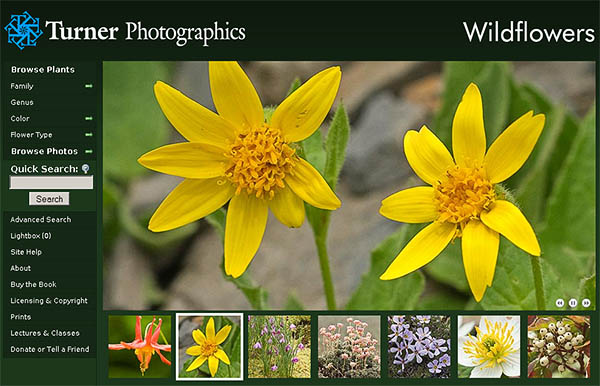
Pacific Northwest Wildflowers splash screen

After several weeks of work by my talented son, Ian, the new Pacific Northwest Wildflowers went live in early May. It’s user friendly, easy to update, and driven by a powerful database. The old functionality of browsing groups of photos based on where and when they were taken is still available, but better organized. New is the addition of all the text and distribution maps for the 1220 plants in the print edition of Wildflowers of the Pacific Northwest. You can browse these entries by plant family, genus, flower color, and flower type, essentially the same way the book is organized.

The powerful feature of the site is its search capabilities. Every page has a ‘Quick Search’ box so you can look for particular plants by Latin or common name or by photo location. Partial words are accepted, i.e. ‘trill’ will find trilliums. There’s also an ‘Advanced Search’ page where you can specify several key search parameters, such as finding all the yellow flowers in the aster family that grow in Crater Lake National Park.

Once you’ve found what you’re looking for you can build your own selection of favorite photos using the lightbox. Just click the little green plus symbol next to a photo to add it to the working lightbox. Click ‘Lightbox’ on the menu to see the contents and from there you can save your selection. When you save you get a URL you can e-mail to a friend or colleague that can be pasted directly in a browser window to quickly display the contents of your lightbox. It’s pretty slick, and doesn’t require logging into the site to use.

For the technically inclined, Ian built the site using PHP, mySQL, and Smarty templates. We’ll put much of the same design and functionality to work rebuilding Turner Photographics in the coming weeks.

Searching for Elusive Plants

Posted on by

Back in 2003 and 2004 I spent the entire growing season searching for wildflowers to include in Wildflowers of the Pacific Northwest. By the time the season ended, there were about 40 plants that Phyllis and I thought ought to be included in the book that I was never in the right place at the right time to find. Now that some time has passed, I’ve decided to try to find and photograph all those I missed, as well as the handful that I messed up the ID.

Black Lily blossoms
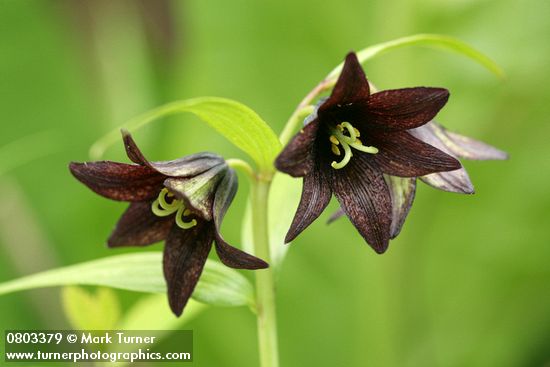
The first really showy plant I’ve found this spring is the Black Lily, Fritillaria camschatcensis, also known as Kamchatka fritillary. It’s widespread in British Columbia, but on the state sensitive list in Washington where it is found in only a few places. I connected with someone who knows where it grows near the mouth of the Fraser River at the edge of Richmond, BC and made a trip to see and photograph it this week. See more photos on the Finn Slough page of Pacific Northwest Wildflowers, my newest website.

Large Mouse Ear Chickweed
Not nearly as much fun, but also missing from the first go-round, is one that turned out to be a common weed in my front lawn. I don’t know how I missed Cerastium fontanum ssp. vulgare, large mouse ear chickweed. I photographed it in the parking strip along Cornwall Avenue just down the street from our house during 5 o’clock traffic while construction was going on in the street. I shot more weeds that afternoon. Those photos are at Bellingham Weeds on the Pacific Northwest Wildflowers site.

I have about 40 plants on my list. One that we decided not to include in the book (because it is a tree) is Pacific crabapple, Malus fusca. I put out the word and several people told me where to find it locally. Some of the plants turned out to be escaped cultivated apples (they have 5 pistals) instead of native crabapples (with 3 pistals). The cultivated apples are in bloom now, but the crabapples are still in bud. I’ve found several specimens, and tore open a bud this afternoon to confirm the pistal count. At least I haven’t missed the bloom, and I’ve enjoyed getting out and looking for plants.

One of the places I looked for the crabapple was in the Connelly Creek Nature Area on Bellingham’s south side. It’s a mixed woodland and wetland area, with a lot of non-natives as well as native species.

Siskiyou False Rue-Anemone

This diminutive very early-blooming plant eluded me when I was chasing flowers to include in Wildflowers of the Pacific Northwest. I spent many hours searching for it, in locations where reliable sources said I would find it, all to no avail. In the end, we left it out of the book. But it’s been nagging at me, or calling to me, or something like that ever since.

Enemion stipitatum

When I received my Native Plant Society of Oregon February newsletter which announced an Emerald Chapter field trip to Mount Pisgah Arboretum to see Enemion stipitatum I decided I just had to drive down. Since it’s about 400 miles from Bellingham to Eugene I inquired a few days in advance whether the flowers had started to bloom. So last Friday I tossed my sleeping bag in the back of the truck, loaded up the camera gear, and headed south. I stopped briefly at the Washington Park Arboretum in Seattle to photograph Witchhazels and then got back into the nasty Friday afternoon Puget Sound traffic on I-5. I slept in the back of my truck at a rest stop just north of Eugene.

I got to Mt. Pisgah early, so got a little exercise by hiking the 1000 feet vertical to the top of the mountain, climbing out of the valley fog into glorious warm sunshine. I ran most of the way back down so I wouldn’t miss the group.

Thirty people showed up for the field trip, which is a large number for a native plant outing. There were concerns expressed about the big group doing damage to the plant we’d all come to see, but as far as I could tell everyone was very respectful of the resource and no little flowers got trampled.

I had expected a small flower, but not quite as small as it turned out to be. Plants were scattered among grasses, fallen leaves, and the foliage of a weedy geranium so you really had to look to find them. The habitat is near the river, where it floods periodically, in open forest of Oregon White Oak (Quercus garryana).

With my tripod as low as it would go, I photographed two specimens of the Enemion, working with a 100mm macro lens and then with an extension tube as well. For some photos I had the camera right on the ground to look the blossoms in the eye. As the fog lifted, I pulled out my diffuser to soften the bright sunlight. You can see all the variations, as well as the two other plants in bloom on Saturday, at Mt. Pisgah on my web pages.

Am I certifiably crazy to drive 800 miles round trip to see one tiny plant?  Perhaps.  But I read about birders flying across the country to see some rare bird.  At least plants don’t take wing before you get there.

Cold Windblown Drizzle

We’re in a period of what passes for miserably uncomfortable weather on the northwest coast.  It’s about 38 degrees, windy, and periods of rain. It feels a lot colder than it really is, colder even than standing around in the snow in the mid-twenties. Days like this seem made for staying inside, which wrecks havoc with any outdoor exercise plan. I did get out three times today, once in the morning for a brisk walk around Cornwall Park while my scanner was busy digitizing slides, then to the post office and an evening meeting downtown.

The weather certainly hasn’t been conducive to photography this week. Not bad enough to look dramatic and not good enough to make beautiful images. Fortunately, the winter blooming shrubs last a rather long time in the cool and damp conditions so there isn’t much that’s pressing in the garden anyway.

While it’s been raining I’ve been busy selecting images for several magazine customers to choose from for future issues. I think my transition to all-digital submissions is nearly complete. Since if one editor is looking for a subject another is sure to seek the same thing in the future, I’m scanning everything that isn’t already digital that needs to go out.  That seems easier for an editor than having to look through both slides and web previews for one story or one issue.

Importance of Deadlines

Without deadlines would I get anything done? Probably, but deadlines sure provide a little extra motivation to move a task to the top of the priority heap.

bellinghamimpcover_thm.jpg

I committed several months ago to give a slide show based on my Bellingham Impressions book, which was published last August. The show dates are this Monday and Tuesday, so today I finally made time to select the photos and sequence them. The show will be all digital, created in Open Office Impress. I already had digital files for everything that’s in the book, as well as a number of other photos I wanted to include in the show, so that part was easy.
For me, the hard part of building a slide show is deciding how to arrange the images so it makes sense and has a nice flow. I didn’t want to mimic the book, which has a color-based design that looks good as 2-page spreads. Print and screen are two very different media. To put the show in sequence I used what seems like an anachronistic technique — I printed thumbnails of every image I might want to include and cut them apart so I had dozens of little squares of paper. Then I started playing with the order, moving pictures around until I was happy. I numbered each photo, then picked up the thumbnails and carried them to my computer so I could page through them as I entered photo file names and built my show. I made a couple of minor revisions to the order and I was done.

Finally, I previewed the entire show and thought about what I wanted to say when each slide was on the screen. I’ll run through the show again on Sunday after I transfer it to my laptop. If you’re in Bellingham Tuesday, come to the Whatcom Museum at 12:30 for the brown bag series in the Rotunda Room and see the show. I’ll have autographed books for sale, too.

Monochrome Palette

wp9c9449.jpg

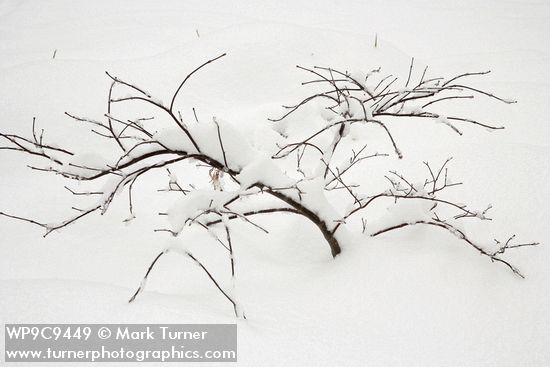
This time of year, especially following several days of heavy snowfall, the color palette is essentially monochromatic. Bare branches exhibit varying shades of gray and muted brown. Snow is bluish-white under cloudy skies and in the shade, or hues of gold under low-angle sunshine. Even the foliage that peeks through the snow is muted in tone — deep green cold-curled Rhododendron leaves, soft brown dry grasses that haven’t yet been buried, and almost-black conifer needles.

I photographed in Coeur d’Alene today, again under gray skies and intermittent heavy snowfall. I revisited a handful of gardens that were riots of color last summer or autumn. Today, I concentrated on shapes and patterns in the structures and bare trees or shrubs. The photo is of a small Japanese Maple.

Tonight, the wind picked up so the trees may be mostly bare on Wednesday morning.  A little sun is predicted, with more snow on the way for the Spokane area.  I’m heading home if I can get across the pass, which was closed all day today due to high avalanche danger.  It’s been a productive three days of snowy photography.