Planting Day

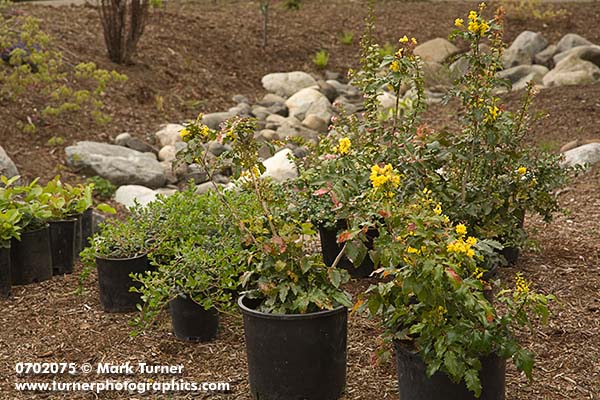
Natalie and I have been working on her mother’s new garden about a mile from our house. We started when she first bought the house with a few shrubs and conifers after Betty had a raised berm and rock-filled dry stream built in the front yard. Those early plantings, now in their third growing season, are looking very nice.Native Shrubs Ready for Planting

Earlier this spring, Natalie and Betty worked up a plan to add many more plants to the front garden, and a layer of taller small trees to the back of the border in the back yard garden. They placed an order with Plantas Nativa in Bellingham, who delivered a truckload of plants a few days ago.

Today we spent the better part of the day placing and planting everything. The photo shows just a small part of what we started with — Shining Oregon Grape (Mahonia aquifolium), Kinnickinick (Arctostaphylos uva-ursi), Salal (Gaultheria shalon), and Evergreen Huckleberry (Vaccinium ovatum). We also planted a couple dozen Sword Ferns (Polystichum munitum) and maybe a dozen Low Oregon Grape (Mahonia nervosa) in the front garden. By lunchtime we were finished with the front and pronounced it good. It will take a little time for the plants to establish and start to fill out, but the end result should be a relatively low maintenance, mostly native garden that is a joy to behold both from the street and from Betty’s large living room window. Continue reading

Waterworks Canyon

This past weekend I was on the east side of the Cascades for a Washington Native Plant Society state board meeting in Ellensburg. We had a productive session all day Saturday, but six-hour meetings are trying even when everyone is on the same track and the discussion is genial. The cure? A day tromping in the field to see what’s blooming.

Sunday, Walt Lockwood and I headed down to Yakima and west another 15 miles to the mouth of Waterworks Canyon. It’s a fairly small canyon tending north-south that drains into the Naches River. The land is on the Oak Creek Wildlife Area, administered by the Washington Department of Fish and Wildlife. There’s a small parking area on the north side of the highway about a quarter mile west of the junction of WA 410 and US 12. [N 46° 44.921′ W 120° 47.874′]

Carey's Balsamroot & Showy Phlox
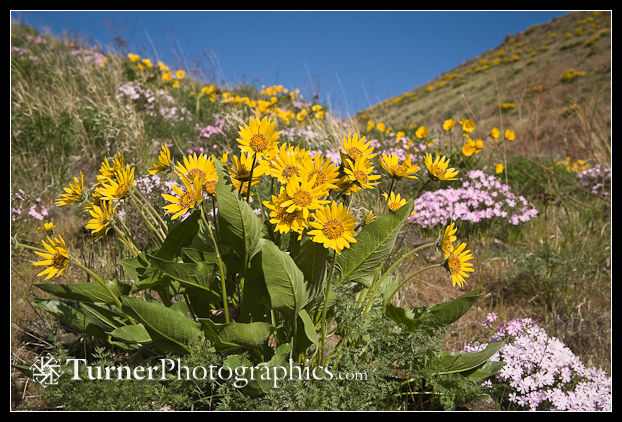
Carey’s Balsamroot & Showy Phlox on rocky hillside [Balsamorhiza careyana; Phlox speciosa]. Waterworks Cyn, Oak Cr Wildlife Area, Yakima Co., WA

The mouth of the canyon is just over 1600′ elevation. After passing through the gate, we were soon greated by spectacular displays of Carey’s Balsamroot (Balsamorhiza careyana) and Showy Phlox (Phlox speciosa), particularly on the east-facing hillside that was bathed in early morning sunshine under a brilliant clear blue sky. Continue reading

Trilliums

One of my favorite wildflowers, dating back to my childhood, is the trillium. I grew up in central West Virginia and in the spring one hillside along the road to my grandparents home was always covered with large white trilliums, Trillium grandiflorum. When I moved to Washington state I learned that our native trillium here, which looks quite similar to the eastern white trillium, is Trillium ovatum. Both of them can be grown successfully in Northwest gardens.

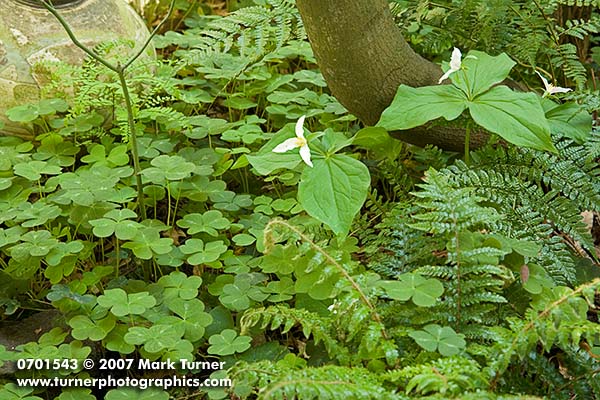
Western trillium among redwood sorrel in a garden

I photographed in a Tacoma-area garden recently where there were a couple of patches of trilliums planted. In this photo, they’re mixed with redwood sorrel, Oxalis oregana, and a non-native fern. This planting is practically inside the house where it can be easily enjoyed. Elsewhere in the garden was a larger patch of trilliums, which had been self-seeding and establishing a rather nice large patch of flowers. The gardener pointed out to me that first-year trillium seedlings have a single leaf, second-year seedlings have two leaves, and not until their third year do they develop their typical three leaves. Continue reading

Red-flowering Currant

One of the prime Northwest native flowering shrubs that’s in bloom right now is red-flowering currant, Ribes sanguineum. It’s a good shrub for the garden, as well as being found at woodland edges in the wild. It has a wide range in the Northwest and is a good early food source for hummingbirds.

Red-flowering Currant in garden border

In this Bainbridge Island garden, red-flowering currants have been planted in several areas around the edge, including in this mixed border. Some native plant gardening enthusiasts are sticklers for only growing natives while others, like this gardener, believe that its OK to mix and match. The currant will stay in bloom for two or three weeks in the spring, and flowers will be followed by rather tasteless blue-black berries mid-summer. The attractive foliage will become a backdrop for other plants that bloom later, like the ‘Autumn Joy’ sedum planted at its base.